
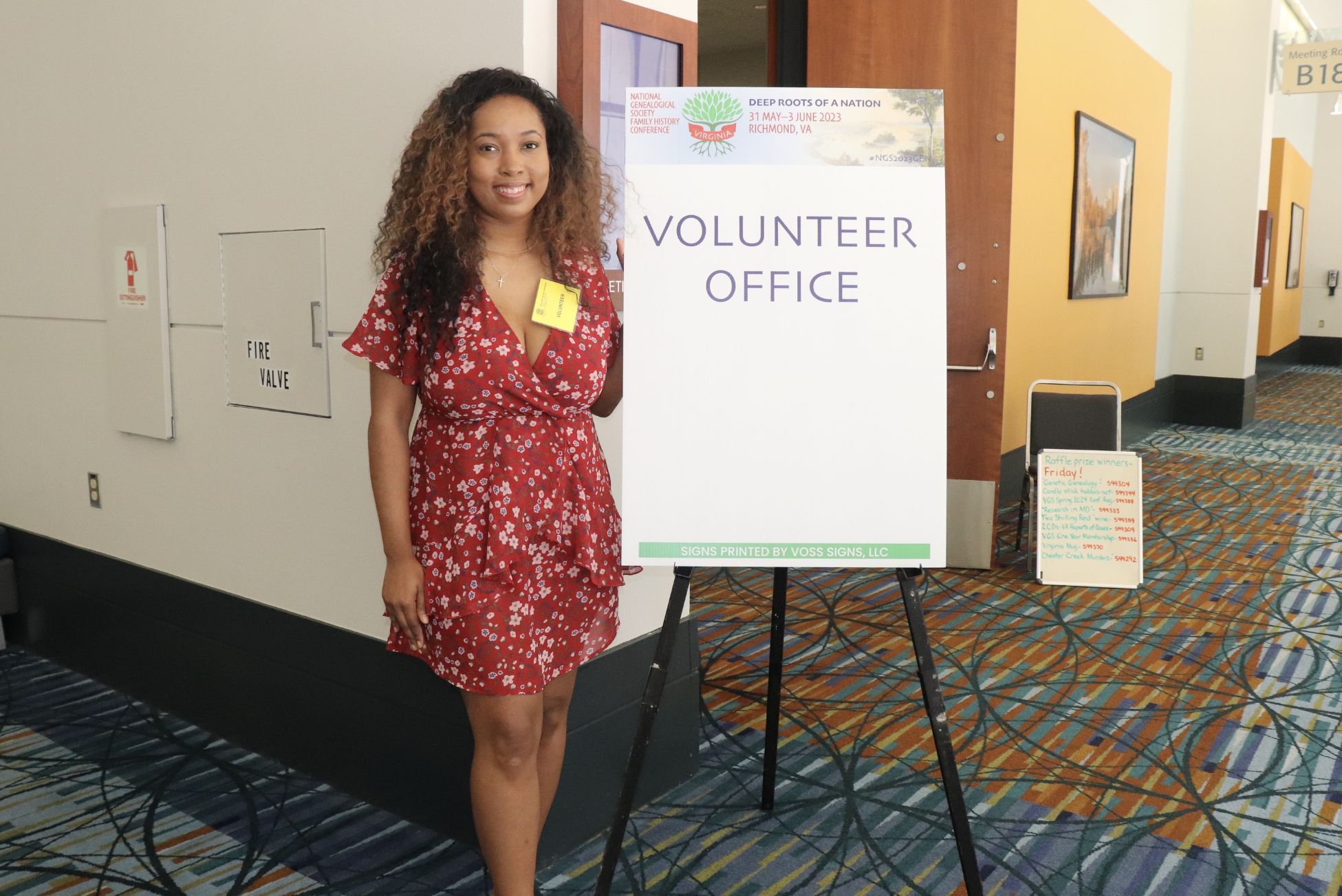
The National Genealogical Society hosted their annual Family History Conference in Richmond, Virginia. Family historians and genealogists traveled from all over the world to attend the four-day event which included a series of lectures, workshops, and research opportunities. The theme for the conference this year was “Virginia: The Deep Roots of a Nation.” Genealogists and historians with specializations in Colonial America or antebellum slavery are often drawn to the collections of genealogical and historical records located at the Library of Virginia which is the state’s library and repository. Attendees were provided with the opportunity to visit the Library of Virginia after hours to conduct research during the conference. During the day the lectures and workshops were held at the Greater Richmond Convention Center which conveniently is only three blocks from the Library of Virginia.
This was the first NGS Family History Conference that I was able to attend because it was only a two-hour ride on Amtrak from Washington D.C. There was a call for volunteers sent out months before the conference, so I signed up to be a volunteer for several events. The volunteer training was conducted via Zoom a few weeks before the conference. The experience was exciting, memorable, and enlightening. I strongly recommend anyone who is interested in attending a conference to seek volunteer opportunities. Not only will you have an enjoyable memory but also volunteering is a great opportunity to network with others in the genealogy community. I was able to see many genealogists, family historians, and even a former library colleague during the conference.
This keynote speaker was Christy S. Coleman, Executive Director of the Jamestown-Yorktown Foundation. Coleman is a distinguished historian and museum professional with decades of experience in the museum industry including the Charles Wright Museum in Detroit, Michigan and the American Civil War Museum in Richmond, Virginia. Coleman served as the President and Chief Executive Officer from 1999-2005. As a child, I loved going to museums and libraries with my mom and vividly remember our first trip to the Charles Wright Museum. As a native Detroiter, I appreciated her giving a shout out to the people of Detroit during her keynote lecture. While I sat in the audience, I was in awe listening to Coleman reflect on her illustrious career. Coleman had a full-circle moment in her career when she was appointed Executive Director by the Jamestown-Yorktown Foundation since she grew up near Jamestown and spent a few summers while in high school working as a historical interpreter at Colonial Williamsburg.
Towards the end of the keynote speech, Coleman discussed the correlations between mainstream media and historical education. More than 50% of Americans engage with history by watching films and television shows. Coleman saw firsthand the positive effect that historical films can have on society when she served as a historical consultant for the acclaimed 2019 film, Harriet. She shared other examples of how television shows and movies can educate larger audiences in meaningful ways. There was a sense of optimism when Coleman discussed the future of preserving and uncovering history, especially in Virginia where history has not only deep roots but also deep pain that can be resolved through transparency and healing. The applause and standing ovation following Coleman’s keynote address set the tone for the conference.
On the same day as the keynote address, the Washington Post published an article entitled “A major group of family genealogists apologizes for past racism.” The article entailed how the National Genealogical Society had banned African Americans from joining the organization during as late as the 1960s. Following the keynote address, the National Genealogical Society announced that they apologized for past racism were plagued the organization for decades. One of the individuals who was denied a membership was an African American archivist at the National Archives named James Worris Moore. Moore was denied admittance into the organization after submitting a membership application in the early 1960s. Two of his descendants were attending the public apology followed by remarks from board members including the chair of the society’s Diversity, Equity, and Inclusion (DEI) Committee, Andre Kearns. The full report can be viewed here.


Leave a Reply